



Foldable 4-Wheel Wheelchair for Small Dogs


Foldable 4-Wheel Wheelchair for Small Dogs
Give your dog support for everyday movement, with a fit that adapts to their body. This adjustable four-wheel wheelchair combines a chest harness, belly sling and rear support to assist small dogs with front and rear limb weakness.

Folding rear supports make assisted breaks and repositioning easier, while removable front wheels allow a rear-wheel configuration when appropriate. Choose Standard or With Support Handle for additional guidance from you.
Choose Your Version

| Version | What’s Included | Key Difference |
|---|---|---|
| Standard | Four-wheel frame, chest harness, belly sling, rear support and support straps. | Adjustable front and rear support with folding rear supports and removable front wheels. |
| With Support Handle | Everything included with Standard, plus a removable support handle. | Helps you guide turns and relieve some front-end weight on gentle slopes or uneven paths. |
Both versions use the same size chart and include the same harnesses and support straps.
Support for Everyday Movement
Front and Rear Support
The four-wheel setup supports your dog at both ends. A chest harness, belly sling and rear support work together to help position the body within the frame, while the wheels assist movement.
Convert from Four Wheels to Two
The front wheel assemblies can be removed to create a conventional rear-wheel wheelchair. This provides another setup option if your dog has sufficient front-leg strength and rear-only support is appropriate for their needs.
Adjustable Fit, Lightweight Frame
Adjust the frame’s length, width and height to suit your dog’s measurements, then fine-tune the harnesses and straps. The hollow aluminum frame keeps the structure lightweight, while breathable, washable fabric supports make everyday care easier.
Folding Rear Supports for Assisted Breaks
Each rear support leg has two adjustable joints: one at the top and one in the middle. Tightening the knobs locks the joint angles for support. Loosening them allows the rear legs of the frame to pivot.

This lets you assist your dog with repositioning, rest breaks or toilet breaks without removing the entire wheelchair each time.
- Support your dog first. Keep them steady before changing the rear support position.
- Loosen the relevant upper and middle knobs. Guide the rear supports into the required position.
- Reset before walking. Return the supports to the fitted position and tighten both joints securely before resuming supported movement.
The folding function applies to the rear supports. The optional support handle does not fold or rotate.
Optional Support Handle: Help When They Need It
The With Support Handle version gives you a convenient place to assist your dog. Use it to help guide turns or relieve some of the weight at the front when moving over a gentle incline or uneven ground.
This extra assistance can be useful for pets with front-limb weakness or weakness affecting all four limbs.
- Removable: Detach the handle when it is not needed.
- Fixed angle: The handle does not rotate, fold down or offer angle adjustment.
- For partial assistance: It is not intended to lift your dog and the entire wheelchair completely off the ground.
Who Is It For?
- Small dogs needing support at both the front and rear of the body.
- Senior dogs with reduced limb strength who need assistance during movement.
- Dogs whose support needs may change between four-wheel and rear-wheel configurations.
- Owners looking for easier assisted repositioning between periods of supported walking.
The right setup depends on your dog’s strength, balance and condition. Ask your veterinarian whether a wheelchair is appropriate and which configuration best suits your dog.
Size Guide
Choose by measurements, not breed or weight alone. Measure your dog while standing in a supported, natural position. If your dog cannot stand independently, have another person support them while you measure.
- A — Body Length: Measure from the base of the neck to the base of the tail.
- B — Body Width: Measure straight across the widest part of the ribcage. This is width, not chest circumference.
- C — Height: Measure from the ground to the hip/back at the rear of the body.
Imperial measurements are shown first, with metric measurements underneath. Weight is a reference only.
| Size | A — Length | B — Width | C — Height | Reference Weight |
|---|---|---|---|---|
| XXS | 7.1–11.8 in 18–30 cm |
≤6.3 in ≤16 cm |
5.9–9.1 in 15–23 cm |
6.6–11.0 lb 3–5 kg |
| XS | 9.1–15.7 in 23–40 cm |
≤7.9 in ≤20 cm |
9.1–13.8 in 23–35 cm |
11.0–17.6 lb 5–8 kg |
| XS-Wide | 11.8–19.7 in 30–50 cm |
≤9.8 in ≤25 cm |
10.2–15.7 in 26–40 cm |
17.6–33.1 lb 8–15 kg |
| S | 11.8–19.7 in 30–50 cm |
≤9.8 in ≤25 cm |
13.8–17.3 in 35–44 cm |
26.5–44.1 lb 12–20 kg |
Breed Examples
- XXS: Pomeranian, Chihuahua.
- XS: Bichon Frise, Toy Poodle, Shih Tzu.
- XS-Wide: Pug, French Bulldog, Corgi.
- S: Shiba Inu, Sheltie.
Breed examples are a starting point, not a fit guarantee. Your dog’s length, width and height must match the selected size. Both Standard and With Support Handle versions follow this chart.
Need help choosing? Send your dog’s measurements to contact@pawpattz.com before ordering.
Getting Started & Everyday Care
- Begin with short, supervised sessions on a level surface, allowing your dog time to become familiar with the wheelchair.
- Adjust the frame and straps so the supports sit securely without rubbing or restricting normal breathing.
- Check the frame connections, harness buckles and both rear-leg joints before each use.
- Support your dog whenever loosening the rear joints or changing the wheelchair configuration.
- Keep the rear harness opening clear for toilet access.
- Give your dog regular breaks out of the wheelchair and check the skin beneath the harnesses.
- Clean the fabric supports as needed and allow them to dry fully before reuse. Wipe the frame dry after outdoor use.
Need Help Choosing a Wheelchair?
If your dog’s front legs remain strong and reliable, rear-wheel support may be sufficient. If the front legs also need assistance, a four-wheel setup may be more appropriate.
For a comparison of wheelchair types and fitting considerations, read our dog wheelchair selection guide, or contact us with your dog’s measurements and support needs.


Real Solutions, Real Results
— Thoughtful Gear for Happy Pets!
⭐️⭐️⭐️⭐️⭐️

⭐️⭐️⭐️⭐️⭐️

⭐️⭐️⭐️⭐️⭐️

Frequently Asked Questions
We purchased this during recovery from a spinal injury. Over several weeks, our dog gradually regained confidence moving on her own. The adjustable frame allowed us to keep modifying the support level as she improved, which made the transition much easier.
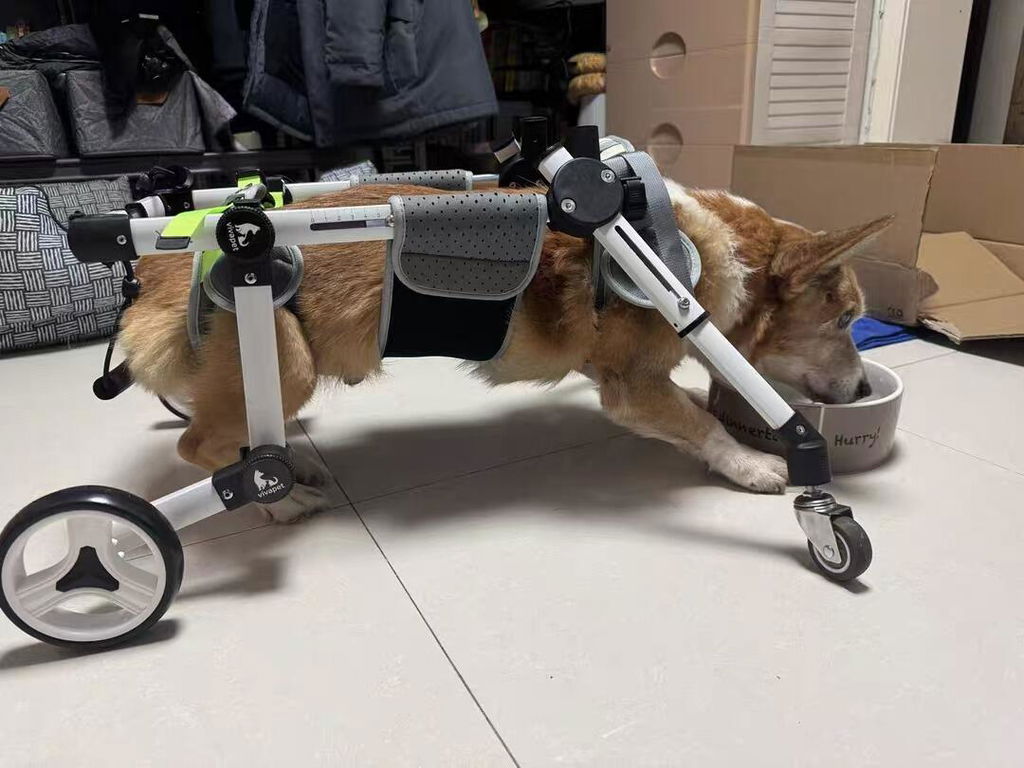
Our corgi had nerve damage and stopped exploring outside. With this wheelchair he started moving around again within a week. He even tries to chase leaves now, which we hadn’t seen in months.
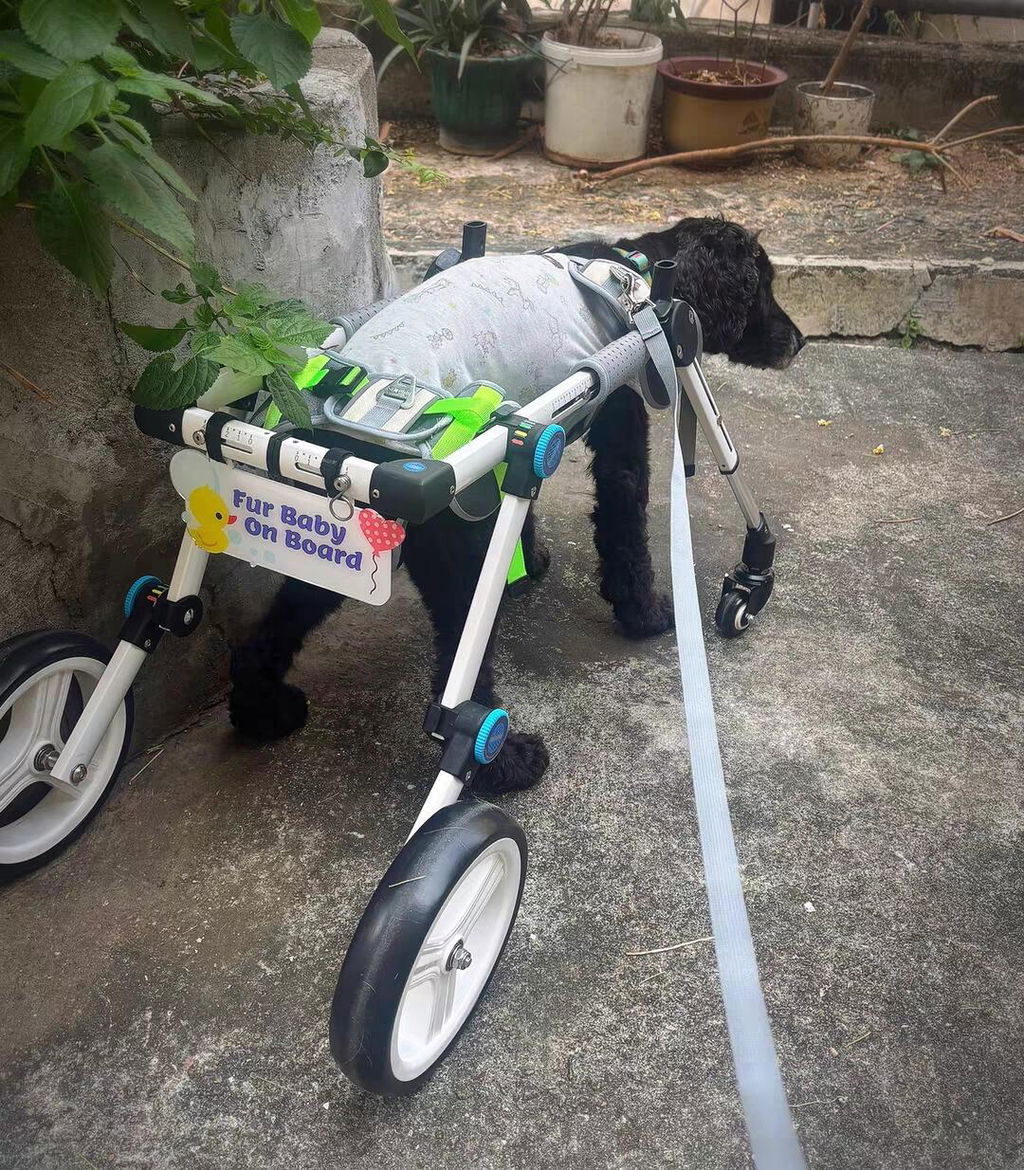
Our older Shih Tzu had gradually stopped walking due to weak hind legs. With this chair she can follow us around again and even goes outside willingly. Seeing her active again means a lot.
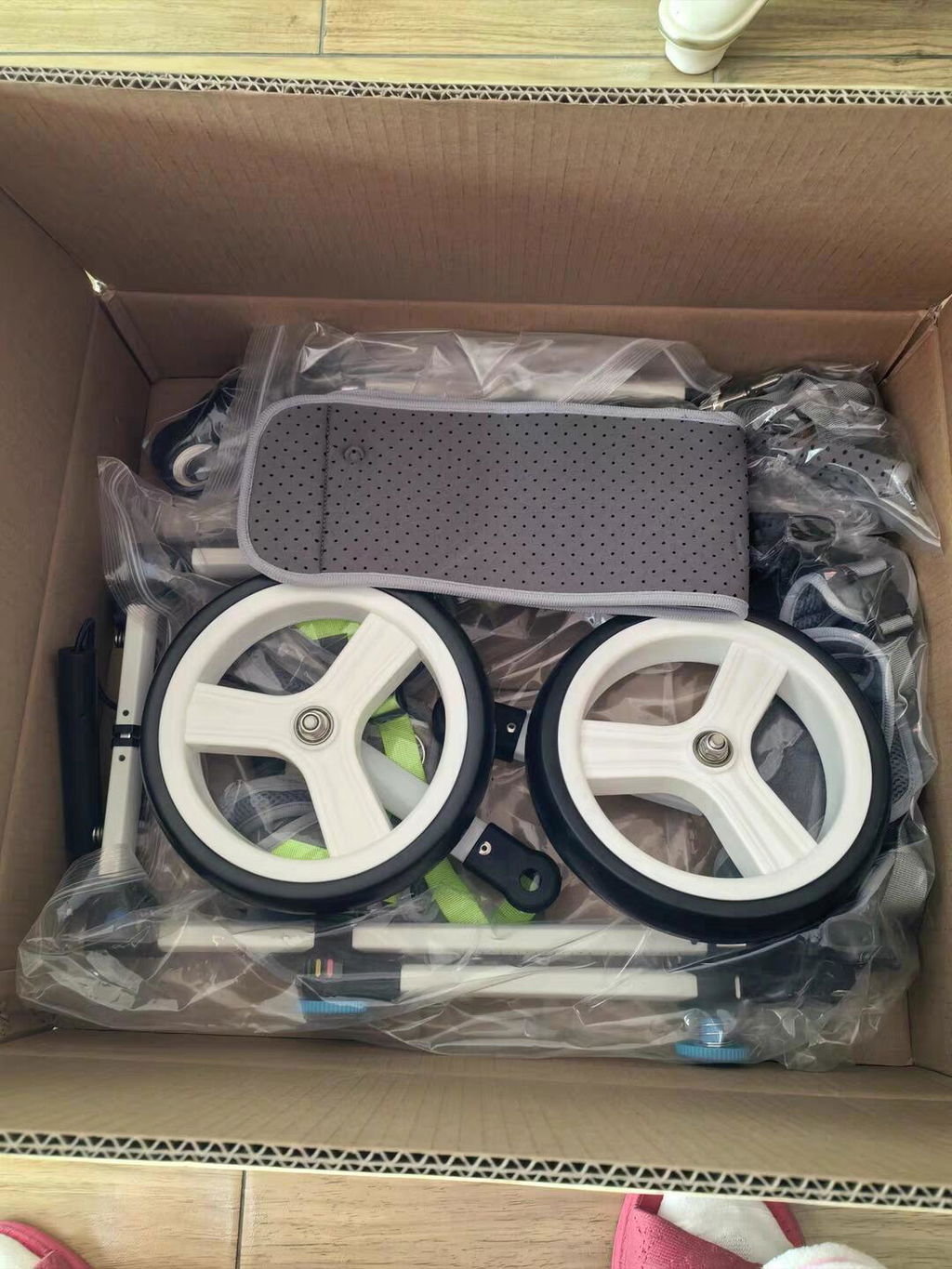
Our little dog has weakness in both his front and back legs, so a regular rear wheelchair wasn't enough anymore. The four-wheel support lets him stand and move without falling to one side, and being able to fold the rear section so he can rest is especially convenient.
I was worried a four wheel chair would be too bulky for my small dog, but the frame is lighter than it looks.
My 13 year old dog had gotten to the point where he mostly stayed on his bed because his legs couldn't support him very well. It took a few days of short sessions, but now he can follow us around the yard again. Seeing him interested in moving around has been really nice.
Getting the harness and frame adjusted correctly took longer than I expected, but after that my dog was able to use it comfortably.
We are currently using all four wheels but I like that the front wheels can be removed later if his front legs get stronger.
It gives her enough support to go outside and do her business without us carrying her the whole way.
There are a lot of ways to adjust it, which is good, but we still haven't found a position where our dog seems completely comfortable. The quality seems fine, just more difficult to fit than expected.
I like that you can change the height, length and width instead of hoping one fixed size fits.
Our dog has weakness after IVDD and needed support for all four legs. This has been very useful for short periods outside.
The wheelchair seems well made, but our dog had a hard time getting used to it. We are still doing short practice sessions.
My dog can turn around and move through the house better than I expected with four wheels.
Gives my dog enough support to stand and walk around without me holding him up the whole time.
The quality is really good overall. It feels stable, well-built, and has made it possible for our dog to move around safely again even with limited mobility.
Fits our small dog well after a few adjustments and he learned how to use it faster than expected.
The first couple of uses were confusing, but once we figured out the straps it became much easier to handle.
Being able to let her lie down without immediately taking the wheelchair off is really useful.
My older dog hadn't been able to walk around the house much on his own. This has made a big difference for him.
Our 14-year-old still enjoys short walks thanks to this. Without it, she would mostly stay lying down all day.
There are quite a few adjustments to make the first time. Once we got everything fitted correctly it worked much better.
It does its job but requires adjustment depending on the terrain. Indoors it works better than on uneven ground.
Both of my dog's front and back legs are getting weaker and the four wheels give him much better support.
I actually bought this for a small goat with rear leg weakness and wasn’t sure about sizing. Customer service was very patient and helped me choose the right fit. It works surprisingly well and I’m really thankful for the support.
The frame is light and doesn't seem too heavy for our little Shih Tzu.
Took some adjusting at first, but once we got the height right my dog moved around pretty well.
Our vet suggested a wheelchair after IVDD progression. This has been very helpful for controlled movement and outdoor time.
My senior dog can move around the yard again instead of just staying in one spot.
Setup took longer than expected and my dog needed a few tries to get comfortable. After that, it became easier to use.
This was better than expected. My only disappointment is my chihuahua is quite small and the XXS is a bit too big. Overall. Very sturdy and worth it.
Thank you so much Debra — really happy to hear it's been sturdy and worth it! 🐾
Sorry the XXS runs a little large for your chihuahua. Try adjusting the frame width, length, and height first, then fine-tune the harness and belly strap for a snugger fit. Feel free to reach out if you need any help!
The overall build quality is better than expected. The frame feels sturdy and stable during use, even on short outdoor paths.